


The WSJ compared Nvidia to Lucent. OpenAI's chip beat Nvidia's best. Bessent's own mentor called the buyback a mistake. Canada hit back. Consumers are getting nervous.
Chips Recovered. Retail Cratered. The Tape Split Down the Middle.
Nvidia (NVDA) snapped a seven-session losing streak. Chip stocks broadly recovered. The 10-year Treasury yield fell for a second straight day. Oil dropped on the war becoming increasingly economic. Gold is on pace for its best month since 1999.
Dick's Sporting Goods (DKS) had its worst day on record. Walmart (WMT) and Target (TGT) also fell. Canada announced retaliatory tariffs on more than 700 U.S. goods. Consumer confidence hit its lowest since January.
Investor Signal
Chips up, consumers down. Both cannot be right for long. One side is pricing a soft landing. The other is pricing a pullback that has already started. Tomorrow's inflation print and Nvidia earnings are the first real test of which side called it.
7 Buy-and-Hold Stocks You’ll Wish You’d Found Sooner
Not every great buy-and-hold stock is a household name. Our 7 Stocks to Buy and Hold Forever report includes under-the-radar leaders quietly dominating their niches - alongside global brands with unmatched staying power.
Together, they form a portfolio core that can produce rising income and steady growth year after year.
You can get the entire list free today… but only if you act before it moves behind the paywall.
The WSJ Tallied Nvidia's Financing Exposure. The Number Is Roughly $230 Billion.
Nvidia has roughly $230 billion in lease backstops and guarantees outstanding. It holds $72.5 billion in equity stakes in its own customers. It guarantees minimum revenue for a single Australian cloud company. The WSJ totalled it and drew one conclusion: Nvidia is now a lender to the AI boom it created.
The Lucent comparison is the point. Lucent financed less-creditworthy telecom companies after deregulation. It guaranteed third-party loans and made off-book commitments. Eventually it shed two-thirds of its workforce and merged. A 2004 SEC complaint over those off-book guarantees settled. A book published the same year on Lucent's collapse put the lesson this way: vendor financing "opened doors that were shut for a reason."
Amazon (AMZN), Alphabet (GOOGL), Meta (META), SpaceX (SPCX), and Tesla (TSLA) all reported negative or near-zero free cash flow last quarter. That is why Nvidia moved downmarket. The $72.5 billion in stakes sits in the smaller cloud companies and AI labs it also backstops, including CoreWeave.
The Vendor Finance Signal
- A downturn used to mean lower chip revenue for Nvidia. Now it means lower revenue, triggered guarantees, and impaired equity at once.
- The Lucent comparison is about structure, not strength. Nvidia has far more cash.
- Hyperscalers carry nearly $1 trillion in leases not yet started.
- CoreWeave (CRWV) expanding margins is the short-term counter to this read.
The ACIE segment is the earnings line to watch tomorrow. It is expected to grow at nearly double the hyperscaler rate. Whether management addresses backstop reserves is the harder question.
The Concentration Signal
The risk is not collapse. It is that one bad quarter at the wrong customers triggers several problems at once. Lucent's failure was not about strength either.
OpenAI Said Its Chip Beat Nvidia's Best. It Said So the Day Before Nvidia Reports.
OpenAI announced its Jalapeno chip outperformed Nvidia's GB300 on two benchmarks: output per watt and response speed. It was built with Broadcom (AVGO) and deploys later this year. A second version is already in development.
Nvidia is backstopping $105 billion in Ohio lease obligations for OpenAI. The company it is financing just said its chip beats Nvidia's most advanced product. OpenAI's chip head noted the company still needs a lot of Nvidia. That line exists because someone asked.
The Inference Competition Signal
- Jalapeno beats GB300 on throughput per watt and latency in public tests
- A second version already in development confirms this is a platform
- OpenAI is Nvidia's single largest financing beneficiary
- The Ohio backstop and Jalapeno are the same relationship seen from opposite ends
Tomorrow's call is where Huang either addresses this or declines to. Either answer tells you something.
The Financing Tension Signal
Nvidia is underwriting infrastructure for a company actively reducing its chip dependence. The lease holds as long as OpenAI pays. The strategic logic gets harder to explain the better Jalapeno performs.
Buffett, Gates and Bezos Quietly Dumping Stocks—Here's Why

The world's wealthiest individuals are making huge moves with their money.
Warren Buffett just liquidated billions of shares. Bill Gates sold 500,000 shares of Microsoft. Jeff Bezos filed to sell Amazon shares worth $4.8 billion.
What is going on? One multi-millionaire believes they are preparing for a catastrophic event. But not a crash, bank run, or recession. It’s something we haven’t seen in America for more than a century.
Bessent's Own Mentor Published a Public Rebuke of the Buyback.
Stanley Druckenmiller published a op-ed calling the buyback "price management," not liquidity management. He trained Bessent at Soros and provided the UK research for the 1992 sterling trade. He is not a critic from the outside. He is the person who taught Bessent how bond markets work.
His argument was clean. No failed auctions. No dealer strain. No forced unwinds. The conditions that justify emergency intervention did not exist. He said every bit of artificial yield suppression subsidizes fiscal delay, and the long bond is the only fiscal discipline the U.S. has left.
The 10-year closed at 4.63 percent for its second straight decline. The market is partly pricing a softer inflation read. It is also pricing the Treasury General Account backstop reported Monday.
The Institutional Pushback Signal
When the person who taught you the trade calls it a mistake, the market notices. Druckenmiller and Warsh share a similar view: let the bond market speak. The gap between that view and active yield management is the question Friday inherits.
Canada Stopped Waiting and Hit Back on 700 Products.
Canada announced retaliatory tariffs on more than 700 U.S. goods ranging from 15 to 50 percent, effective September 8. Steel, aluminum, dairy, and seafood are on the list. Trade Minister LeBlanc: "We're not waiting by the phone."
The January date Trump set for higher auto tariffs looked like a window to negotiate. Canada read it differently. Firing back now removes that window. Both sides enter USMCA review having already escalated.
Ford (F), General Motors (GM), and Stellantis (STLA) all fell Monday on the auto tariff threat. September 8 means supply chain disruption hits Q3 earnings calls, not future guidance.
The Trade Escalation Signal
More than 700 goods means coverage is broad, not surgical. Formal USMCA talks have not even started. Q3 earnings in October are the first real accounting of actual cost impact. Canada concluded the January date was leverage, not an offer. It answered accordingly.
Why are companies flying spy planes over Elon's closely-guarded AI lab?
Elon did the seemingly impossible – far faster than anyone expected...
And it's sent the tech industry into PANIC MODE.
ChatGPT, Claude, Google Gemini, and DeepSeek could soon become obsolete.
And three little-known firms could soar 10X or higher as a result.
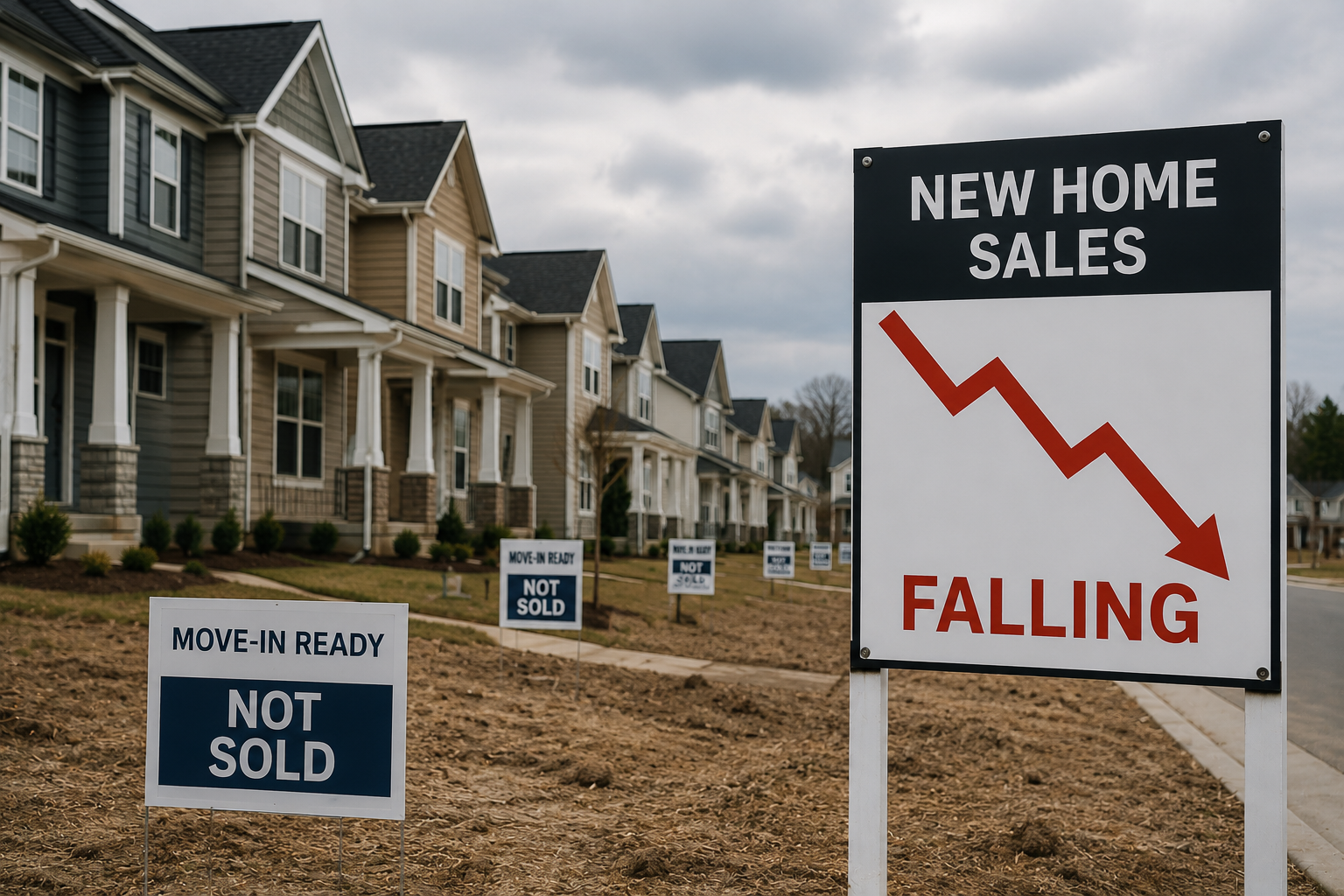
New-Home Sales Fell. Confidence Hit a Seven-Month Low. The Cracks Are Getting Harder to Ignore.
New single-family home contracts fell to a 607,000 annual rate in July, missing the 620,000 consensus. Sales have declined in three of the last four months. The Conference Board's confidence index fell 0.8 points to 89.4, its lowest since January. The internals split hard: the six-month expectations component dropped 5.8 points to 68.2 while the present situation reading jumped 6.8 points to 121.2.
The survey ran while gas averaged above $4 a gallon. A 12.6-point divergence between what consumers see now and what they expect in six months is the signature of a consumer still spending but quietly bracing.
The Spending Inflection Signal
- Current conditions at a four-month high, forward expectations at January lows. That split resolves one way.
- DKS named footwear and athletic apparel as in active contraction
- Gas above $4 during the survey window ties the Iran campaign to consumer behavior directly
- Walmart and Target falling the same day confirms this is not company-specific
DKS had its worst day on record. Walmart and Target fell alongside it. The footwear and athletic category does not crack alone.
The FOMC Overlay Signal
Strong present conditions plus weak forward expectations makes tomorrow's inflation read harder to interpret. Inflation still running while consumers pull back on the outlook is not a clean picture for anyone setting rates on Friday.
Five stories. Each critique came from someone inside the structure.
Nvidia's largest customer said its chip beats Nvidia's. Bessent's mentor called the buyback a mistake. Canada answered the January tariff threat rather than waiting. Consumers logged their best current read in months and worst six-month outlook since January. The WSJ traced Nvidia's financing and reached for Lucent.
Tomorrow brings the two numbers that settle it.
