


Record bond ETF flows the day before Bessent's buyback raised questions. The US-Canada tariff framework cuts steel and auto tariffs. OpenAI's IPO was pushed to 2027. Chinese AI took 60% of global developer market share. Hudson River posted a record quarter.
Asia Surged. WTI Spiked. The Buyback Relief Is Already Fading at the Long End.
The Kospi surged sharply Thursday. Samsung and SK Hynix both jumped hard after SK Hynix accelerated its $28.7 billion buyback. The Nikkei rose. Asia broadly rallied.
WTI surged past $87 on Trump's economic warfare declaration and the UAE suspending trade with Iran. The 30-year Treasury yield edged back higher from Wednesday's drop. The structural pressure was paused, not resolved. Gold pulled back slightly.
Bitcoin continued climbing past $69,000. Coinbase (COIN) and Robinhood (HOOD) gained. U.S. national debt officially crossed $40 trillion Tuesday. Walmart (WMT) reports before the bell.
The Signal
The 30-year yield moving back up within 24 hours of Bessent's buyback intervention is the institutional tell. The intervention bought a day. The structural forces, AI supply, fiscal deficits, and Iran-driven oil, are still present. Walmart earnings and jobless claims are the two economic reads that tell you whether the consumer is holding while the bond market reprices.
Nuclear Stocks Are Surging — These 7 Lead the Pack
Nuclear stocks aren’t creeping higher — they’re breaking higher in waves.
Multiple names posted 40%+ gains last year as uranium prices climbed and plans emerged for hundreds of new reactors over the coming decades.
Producers are benefiting from rising uranium prices, while service providers are locking in long-term contracts and infrastructure spending adds another layer of demand.
Our analysts identified the companies positioned to benefit from multiple angles in a FREE report: 7 Top Nuclear Stocks to Buy Now.
Record Bond ETF Flows Hit the Day Before Bessent's Buyback. The Timing Is Now a Question.
Record inflows hit the PIMCO 25+ Year Zero Coupon US Treasury ETF on Tuesday, with trading volume nearly double the prior 2024 peak. Early Wednesday, Bessent announced the doubled buyback operation targeting the same 10-30 year duration segment.
The ETF carries a roughly 28-year effective duration. A single percentage point yield decline moves prices roughly 28%. The Tuesday flow landed in the most rate-sensitive Treasury instrument, one day before the announcement that moved it.
The Scrutiny Window
- Record Tuesday inflows into the most duration-sensitive Treasury ETF
- Buyback doubled to $4B targeting the same duration segment 24 hours later
- Wednesday WSJ called Bessent "America's Bond Trader in Chief"
- Bianco Research called it the moment Bessent started panicking
The institutional question about information leakage is now on the record. Jackson Hole next week is the next institutional communication event. Whether Warsh responds to the intervention or ignores it will define whether the buyback is monetary or fiscal policy in market framing.
The Political Frame
Treasury buybacks are operational tools, not emergency responses. Framing this one as political is now the named institutional narrative. It shapes every subsequent buyback announcement.
The US-Canada Tariff Framework Cuts Steel to 25% and Autos to 15%. Algoma Won. Nucor Lost.
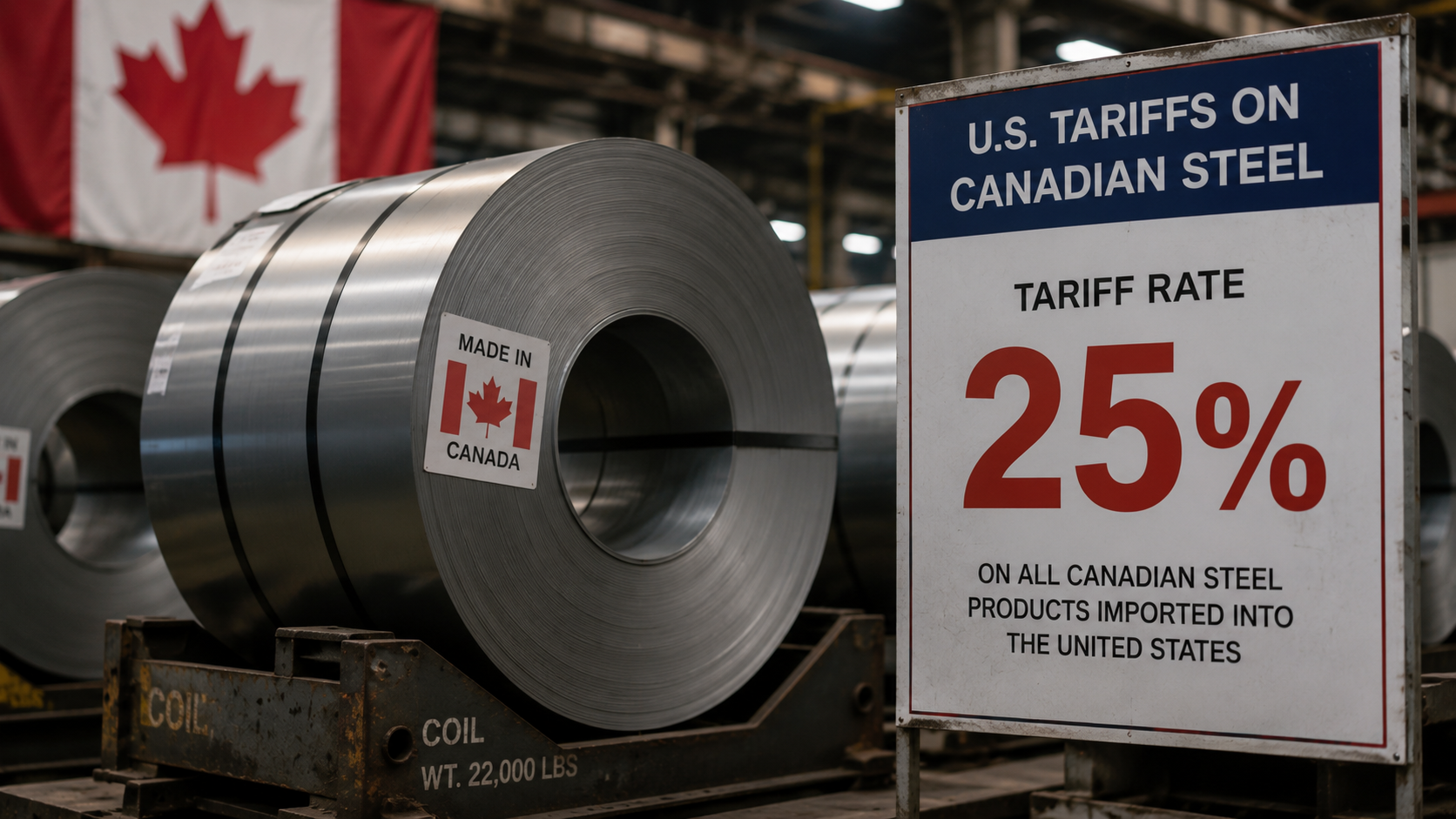
The tentative US-Canada framework lowers Canadian steel and aluminum tariffs from 50% to 25% and auto tariffs from 25% to 15%. Algoma Steel Group (ASTL) jumped sharply. Nucor (NUE) and Century Aluminum (CENX) both fell.
The auto tariff matches Japan and Korea's rate. The steel tariff matches the UK's preferential level. The deal is not final, with alcohol distribution still pending. Friday is the deadline.
The Sector Split
- Canadian steel makes up roughly half of U.S. aluminum consumption
- Ford (F) and GM (GM) have deeply integrated Canadian supply chains
- Alcohol distribution ban remains the outstanding friction point
The Algoma rally and Nucor decline name the zero-sum nature of the tariff reduction for domestic producers. Every ton of Canadian steel that enters at 25% competes with domestic production. The domestic steel industry's lobbying to preserve 50% derivative product tariffs is the institutional response to that arithmetic.
The Precedent Effect
UK steel at 25%, Japan and Korea autos at 15%, Canada now matching both. The bilateral precedent is set. Every next negotiation starts at those rates.
Is Elon About to Create a New Generation of Millionaires?

When Elon took SpaceX public, an estimated 4,400 employees became millionaires – with top executives, welders, and even cafeteria workers getting rich overnight. Sources close to Elon indicate that he's about to hatch a new opportunity to create generational wealth – and you don't have to work for Elon to see massive potential profits. Click here for the full details.
This ad is sent on behalf of InvestorPlace Media at 1125 N. Charles Street, Baltimore, Maryland 21201. If you're not interested in this opportunity, please click here.
OpenAI's IPO Was Pushed to 2027. Anthropic Goes First. The Gap Is Now Structural.
OpenAI CFO Sarah Friar told employees the company will be public by 2027. Anthropic is expected to IPO as early as October. OpenAI's Q2 revenue was $6.7 billion with widening losses. Anthropic's was $11.5 billion with positive operating income. The revenue gap now extends into the IPO timing.
Fractile raised $600 million at $6.5 billion, six times its May valuation, on a $250 million Anthropic supply deal. Chips ready in 2027. Anthropic's supply chain is being financed at venture valuations ahead of the IPO.
The Timing Gap
- Anthropic targeting October 2026, OpenAI confirmed 2027 at earliest
- Anthropic run rate at $65 billion, OpenAI at $40 billion in July
- Fractile chip readiness aligns with OpenAI's 2027 IPO window
Anthropic being first to market gives it the right to set the AI lab comparable. If Anthropic prices at $2 trillion, OpenAI's 2027 range is anchored below. First mover in AI IPOs is also the price-setter.
The Downstream Signal
Fractile jumped from $1 billion to $6.5 billion in three months on a single Anthropic supply deal. Every compute vendor in Anthropic's supply chain is being repriced ahead of the IPO.
Chinese AI Models Took More Than 60% of Global Developer Market Share. The Cost Gap Is Structural.
Chinese AI models held more than 60% of OpenRouter traffic last month. Moonshot's Kimi K3 nearly matches Anthropic's top model at roughly a third of the cost.
Airbnb (ABNB), DoorDash (DASH), and Coinbase already use Chinese models hosted on U.S. servers. Building equivalent applications costs roughly 12 times more with Anthropic's top model than with the comparable Chinese alternative. That is structural.
The Cost Structure
- Kimi K3 priced at roughly a third of Anthropic's top model
- DeepSeek V4-Pro priced well below Western rivals even after increases
- Alibaba open-weight models hit 3 billion downloads in six months
The 60% OpenRouter market share is last month's data, not a projection. The question is not whether Chinese AI is competitive. It is whether policy intervention arrives before the dependency is locked in.
The Policy Window
Chip export controls were designed to prevent Chinese AI advancement. The models are already here. The access controls that matter now are on model use, not chip manufacturing. That toolkit is not yet deployed.
On September 8th, a powerful new law signed by President Trump
will trigger a radical shift in America’s money system...
When a small group of private companies — not the Fed — will perform a major mint of a new kind of money.
And those who act before this new system fully kicks in could see gains as high as 40X by 2032.
But those who fail to prepare will be blindsided by this sea change to the U.S. dollar.
Go here now for the details — before the September 8th mint hits the market.
Hudson River Trading Posted Record Q2 Revenue. Jane Street Lost $15 Billion That Same Month.
Hudson River Trading posted Q2 revenue of $11.4 billion, more than four times the year-ago figure. Adjusted EBITDA nearly quadrupled. HRT turned a profit in July despite the Situational Awareness dislocation, while Jane Street (JSI) recorded its first monthly loss in a decade.
HRT had no direct Situational Awareness exposure. Jane Street had substantial exposure. Staying out produced a record quarter. Taking direct exposure produced the worst month in ten years.
The Market-Maker Split
- HRT EBITDA nearly quadrupled year over year in Q2
- Jane Street (JSI) suffered its worst monthly result in a decade
- HRT adding longer-horizon strategies to supplement high-speed trading
HRT's record quarter is the institutional signal that the Situational Awareness unwind did not damage the non-bank market-maker category. It damaged Jane Street specifically and benefited HRT specifically. The next Citadel Securities quarterly result is the third data point in the same category split.
The Franchise Question
Jane Street's year-to-date revenue still exceeded all of 2025. The franchise is intact. But the documented $15 billion loss creates a reputational overhang that reprices its prime brokerage relationships heading into Jackson Hole.
Record bond ETF inflows the day before Bessent's buyback announcement are now under scrutiny. The US-Canada tariff framework cuts steel to 25% and autos to 15% in the biggest tariff reduction of the cycle. OpenAI pushed its IPO to 2027, giving Anthropic the first-mover advantage. Chinese AI models hold more than 60% of global developer market share at a fraction of U.S. pricing. And Hudson River Trading posted a record quarter while Jane Street absorbed the AI trade's biggest loss.
Walmart reports before the bell. Jackson Hole August 27. Nvidia August 26.
