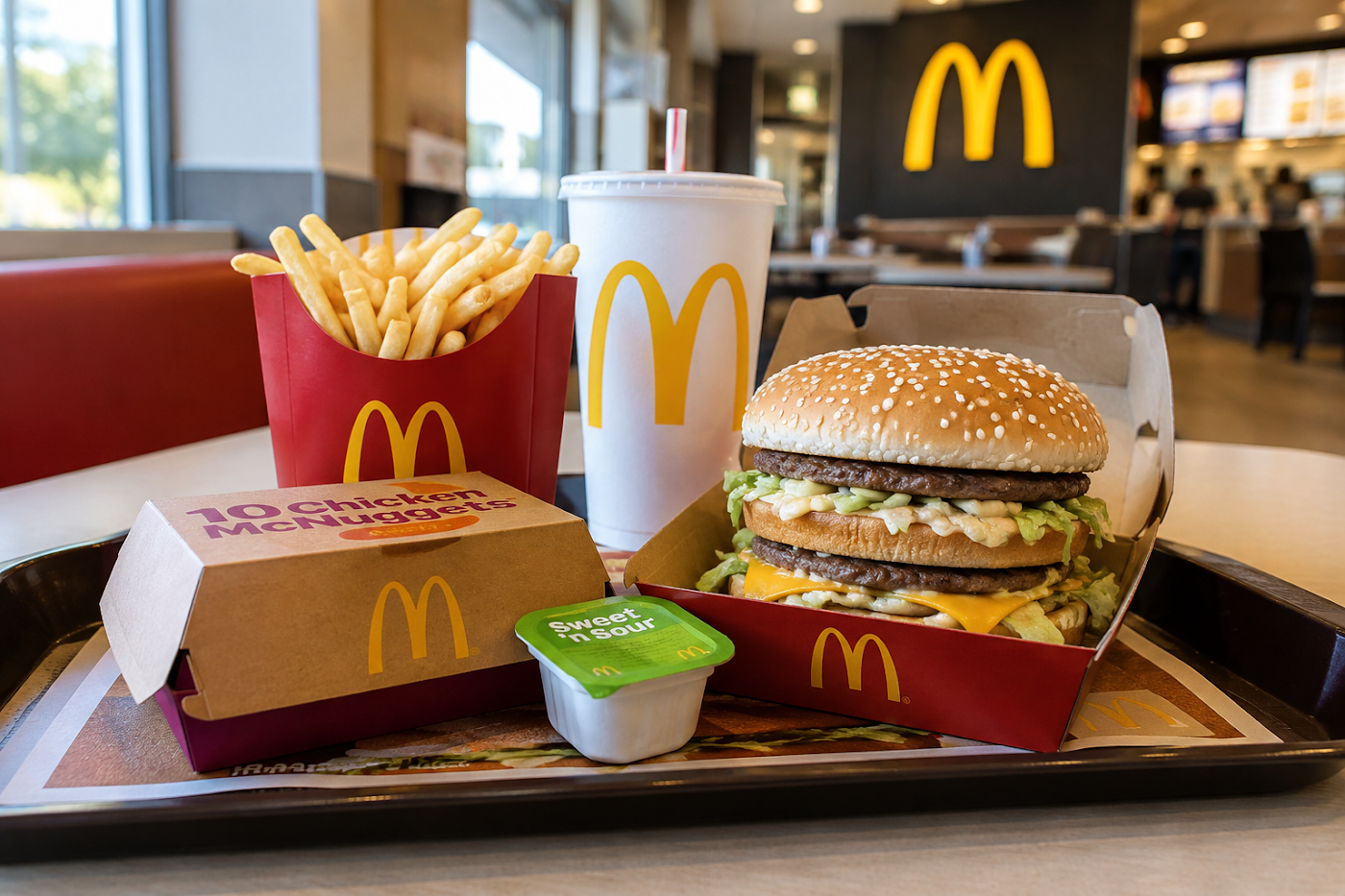
MARKET PULSE Good News on Growth Sent Yields to a 2007 High. Stocks Fell.S&P 500 and Nasdaq both fell. The 10-year jumped to 5.13 percent, its highest since July 2007, on a single session where strong business activity, rising oil, and a Fed governor all pointed the same direction. The PMI print triggered the move. Then Fed Governor Barr said more hikes are likely needed. Then the Treasury announced a $6 billion buyback, matching the last operation, which disappointed markets expecting more. Three separate catalysts landed in sequence, each adding basis points to the same yield. McDonald's (MCD) fell sharply after its investor day. KB Home (KBH) cut guidance. Six Flags (FUN) rose after Jana Partners pushed for a sale. European gasoil futures surged on Trump's diesel export comments. Energy Secretary Wright publicly called a ban a blunt tool that does not work. Investor Signal Tuesday the AI trade set prices for other industries. Wednesday the economy underneath it set the price of money. Three separate catalysts hit the same yield in one session, and none of them were the Fed. PREMIER FEATURE Wall Street Owns 88% — Yet Most Investors Don’t Know the NameInstitutions already control 88% of this little-known company. BlackRock owns roughly 32 million shares. Vanguard owns about 48 million. And management authorized a 40-million-share buyback. One man believes Wall Street may see something Main Street has missed. Click here to learn more ECONOMY WATCH Business Is Booming. That Is the Problem.The fastest growth since 2021 came with the fastest input cost increases since 2022. S&P Global's flash composite PMI reached 58.4 in September, the highest since July 2021. Services hit 58.7, manufacturing 57. Hiring grew at the fastest pace in more than four years. Chris Williamson of S&P Global called it one of the greatest improvements recorded outside the post-pandemic reopening. The cost line arrived in the same sentence. Input prices rose at the fastest rate since 2022, driven by fuel and transport. Supply chain bottlenecks lengthened delivery times to their worst since mid-2022. Markets read it immediately. The 10-year jumped. Fed Governor Barr said risks to the inflation target have increased. October hike odds pushed above 70 percent. Ceasefire Doesn't Fix This The comfortable read was that this inflation is a war import that fades when the war does. A five-year high in activity, with hiring at its fastest since February 2021, is a demand story running alongside the fuel one. A ceasefire removes the oil shock. It does not remove the PMI. That leaves the Fed two arguments for hiking and only one of them resolves in the Middle East, which is why good news on growth now prices as bad news on rates. HOUSING WATCH Nearly One in Ten Mortgage Applicants Chose the Adjustable Rate.The last time this many buyers reached for an ARM, rates were on the way down. The 10-year reaches households through the mortgage. The 30-year contract rate rose to 7.12 percent, the highest since May 2024. Total applications fell. Refinancings dropped and are more than 60 percent below a year ago. The adjustable-rate share jumped to 9.8 percent from 8.4 percent the prior week. During the pandemic's record-low rate years it was barely 3 percent. The five-year ARM rate actually fell during the week the fixed rate rose, creating a spread more than a full point wide. Nationwide's Ben Ayers described housing as in a recession by itself, but probably not deep enough to drag the broader economy. Borrowing Affordability From the Reset Date An ARM is a bet that rates fall before the reset. Nearly one in ten applicants is now making that bet, at the same moment the bond market is pricing additional hikes. Those two reads cannot both be right. Buyers are pricing relief the bond market is not pricing. A rising ARM share while fixed rates climb is not a return of demand. It is affordability being deferred. FROM OUR PARTNERS WARNING: A Major Market Shift Could Hit Stocks in 2026If you have any money in the stock market, you may want to pay attention. New research points to a massive market-moving event that could send hundreds of popular stocks into a sudden free fall. Holding the wrong stocks when this hits could erase years of gains. That’s why analysts have now identified a list of stocks investors may want to avoid as this event unfolds. If you want to see what’s coming — and which stocks could be most at risk — Click here to get the full details before it’s too late. RESTAURANTS WATCH McDonald's Wrote an $8.5 Billion Check and Called Flat Traffic Simply the Environment.The chain stopped waiting for conditions to improve. It stopped calling them difficult too. Those same input costs run through every franchisee's P&L. McDonald's committed roughly $8.5 billion through 2036 for franchisee rent assistance and capital improvements. Shares fell more than 5 percent. CEO Chris Kempczinski said the company needs to stop calling it a difficult environment. It is simply the environment now. Beef costs have nearly doubled over five years in its biggest markets. Traffic in major markets is expected to stay flat. Growth has to come from rivals' customers. The plan targets 1.5 percentage points more of global chicken and beverages by 2030, through hand-breaded chicken, AI drive-through ordering, and Red Bull-infused drinks. $8.5 Billion Is the Bet The old playbook was to discount through a soft patch and wait for traffic. McDonald's just told investors the soft patch is the baseline, with beef costs nearly doubled in five years and traffic expected to stay flat. That leaves one source of growth, which is rivals' customers, and $8.5 billion is what it costs to fund the operators who have to go take them. Investors read a decade-long commitment with no economic tailwind behind it and took 5% off the stock. Every chain chasing the same flat traffic now competes with someone who has stopped waiting for conditions to improve. SEMICONDUCTORS WATCH Chip Stocks Ran Six Days. Their Credit Markets Didn't Follow.Equity investors bid the chips up. Credit investors charged more to insure them. The semiconductor ETF pulled back after a 15 percent six-day run. Mott Capital's Michael Kramer noted that credit default swap prices on the same chipmakers have been rising alongside their stocks. That relationship is normally inverse. The last time it looked like this, the chip rally did not last. BTIG's Jonathan Krinsky counted roughly a third of the PHLX Semiconductor Index more than 30 percent below their 52-week highs, with the average member down about 26 percent from its peak. The index sits about 14 percent below its June high. HSBC remained overweight on equities and said hyperscaler credit spreads look like they may be peaking, the counter-case. One Market Disagrees With the Other Tuesday's newsletter noted bond buyers charging hyperscalers like weaker credits. This is that signal one layer down the supply chain, in the chipmakers selling to those same hyperscalers. Two markets pricing the same companies differently is information. One of them specializes in pricing default risk. PARTNER SPOTLIGHT Is Elon About to Create a New Generation of Millionaires?
When Elon took SpaceX public, an estimated 4,400 employees became millionaires – with top executives, welders, and even cafeteria workers getting rich overnight. Sources close to Elon indicate that he's about to hatch a new opportunity to create generational wealth – and you don't have to work for Elon to see massive potential profits. Click here for the full details. This ad is sent on behalf of InvestorPlace Media at 1125 N. Charles Street, Baltimore, Maryland 21201. If you're not interested in this opportunity, please click here. ENERGY POLICY WATCH Trump Floated a Diesel Ban. His Energy Secretary Called It a Blunt Tool That Doesn't Work.A rare thing in this cabinet: a secretary publicly disagreeing with the president. Energy Secretary Chris Wright, a day after Trump said he was weighing diesel export limits, said the blunt tool of banning exports "definitely doesn't work." His logic is storage. Refiners that cannot export run out of tank space and cut production, which raises gasoline and jet fuel prices. By late morning Wright offered voluntary restrictions instead. Details were thin. Industry lobbyists noted that refiners discussing restrictions could raise antitrust concerns. A White House official said Trump is evaluating all options. S&P Global estimates a ban would force refiners to cut runs by roughly 12 percent. Iowa Republicans including Senator Chuck Grassley support it. Political pressure runs the other way from economic logic here. Same Inflation, Opposite Tools The question has moved from whether Washington acts to which instrument it picks, and the two are not equal for refiners. A ban forces run cuts and pushes gasoline higher; a voluntary cap is a negotiation with no named volume, and the Atlantic Council's Ben Cahill notes it's easier to lift, since unwinding a ban means a visible diesel rebound nobody wants to own. Until a volume is named, the risk to refiners is a headline. Once one is, it becomes a margin. And the two policies now aimed at the same inflation pull opposite ways: Warsh is raising rates to cool demand while Washington looks at holding diesel at home to cut pump prices, so whichever works first decides how much further the Fed has to go. CLOSING LENS Business activity at a five-year high, input costs at a four-year high, and the 10-year at 5.13 percent. Housing borrowers went adjustable. McDonald's said this is not a difficult environment, it is the environment. Chip credit diverged from chip stocks. The energy secretary broke with the president on diesel. Tuesday the AI trade set prices for industries that never signed up for it. Wednesday the economy underneath it set the price of money. The Fed was already hiking. Now growth itself is making the case for more. Trump meets Xi tomorrow. That is the conversation that determines whether any of this eases. 3 STOCKS OUR SIGNAL ENGINE SAYS TO WATCH CAREFULLY Three stocks. Three signals. Two weeks later, the story changed.On September 2, we published three market questions around KLAC, HPE and PG&E.
Two weeks later, every one of them produced new evidence. One company delivered record revenue and raised its outlook.
Another saw weakness spread across its entire peer group.
And in the third, a market risk that had only been showing up beneath the surface suddenly became explicit.
Yet none of these stories is finished. That’s why we built Market Tell.
To track the signals that keep moving after the headline is gone — and show you what investors should be watching next. We’ve put the latest analysis into a new FREE Special Report:
3 Stocks at a Major Turning Point See what changed… what still hasn’t been resolved… and the signals we’re watching now. Get the Free Report → |