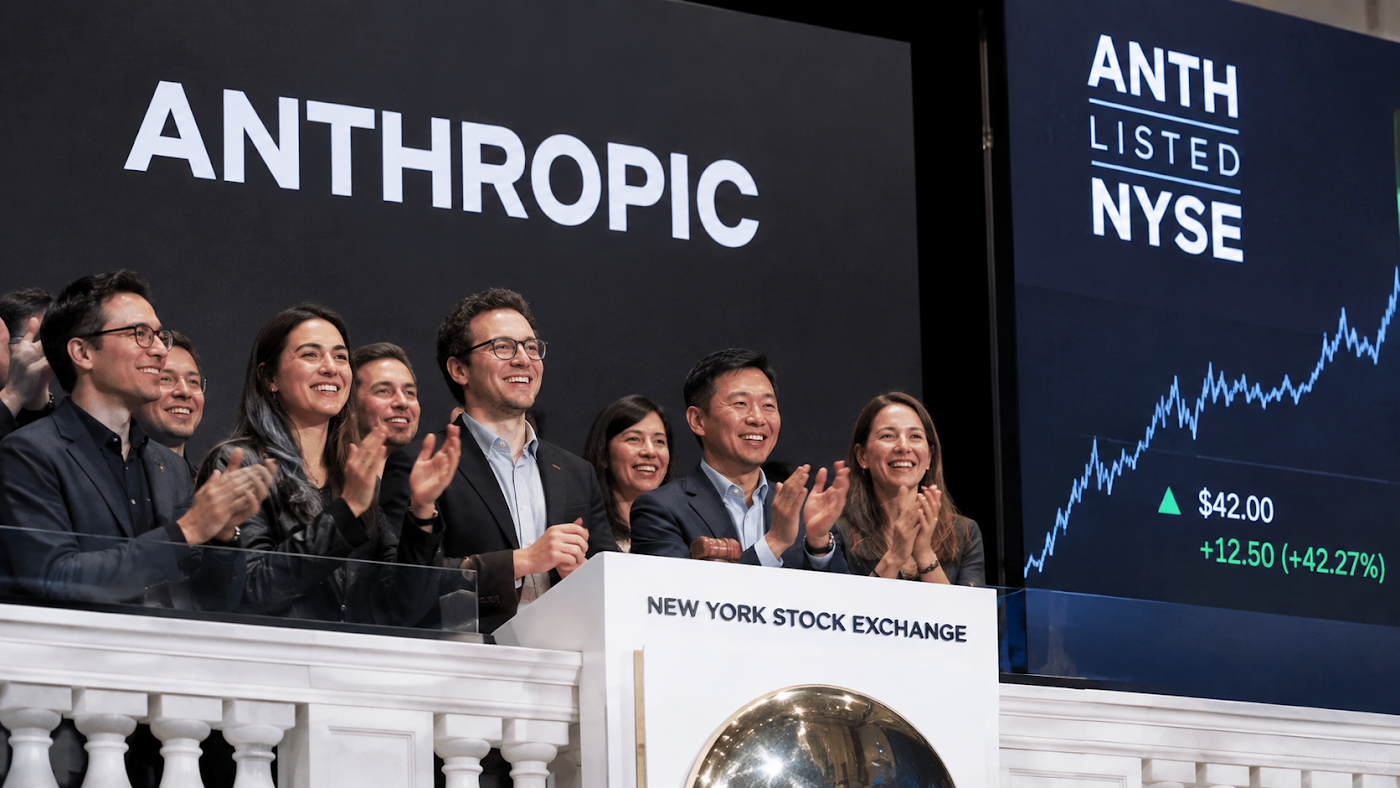
MARKET PULSE The Builders Started Putting It on the Record. The Market Opened Cautiously.S&P 500 and Nasdaq futures opened near flat after Monday's losses. Dow futures is also up slightly. Yields eased a fraction from Monday's highs. WTI pushed above $93 on continued Middle East supply anxiety, with Iran and the US in indirect talks through Qatar. AMD (AMD) announced an $8.2 billion acquisition of World Labs, the AI company founded by Fei-Fei Li. The 30-year mortgage hit 7.50 percent overnight. Michael Burry moved up his AI bear timeline and switched to put options for more leverage. Consumer confidence and JOLTS data release today. Investor Signal Two things arrived before the open that point in opposite directions. Anthropic's prospectus describes existential risk and lists $518 billion in compute obligations. AMD spent $8.2 billion on a new AI category. Both are data points about where the trade is heading. PREMIER FEATURE I've Read a Lot of Mining Filings. They All Sound the Same.This one stopped me cold. Sitting in the filings of one small American gold company is a phrase I have never seen on a gold project: substantial support and partnership from the Department of War. The Department of War does not partner with gold miners. Except it's partnering with this one. Here's why. The deposit carries a second metal — one China formally banned from export to the United States. The only domestic reserve of it in the country. Gold for the dollar war. The banned metal for the shooting war. Both from the same pit. Washington didn't stop at words. On May 21, 2026, a federal bank voted unanimously to lend nearly $3 billion to build it. Congress got 25 days notice. Nobody objected. When final papers are signed, funding risk goes to zero — and Wall Street re-rates the stock from speculative developer to federally backed strategic asset. The company is about one fiftieth the size of Newmont. Read the filing for yourself AI CAPITAL WATCH Anthropic Put "Existential Risks to Humanity" in Its IPO Filing.Eighty pages of risk factors. Forty-eight on the business. The ratio alone tells a story. Anthropic's 261-page prospectus devotes about 80 pages to risk factors and 48 to describing the business. SpaceX used 38 of 277 pages on risk. The filing warns models could develop "self-preserving behaviors," including attempts to "resist shutdown" and behavior "resembling blackmail." The company also says that model awareness of its own evaluation creates a significant limitation on its ability to assess safety. Revenue grew twelvefold in 2025 to nearly $4.6 billion, with a $42 billion net loss that is mostly an accounting charge. Future compute obligations total $518 billion against just over $20 billion in cash. Nearly a quarter of revenue came from two customers. Seven co-founders control just over half the voting power. Investor Signal A prospectus is a legal document written to survive litigation, which gives its warnings a weight that speeches and essays lack. Anthropic is telling prospective buyers that its models may resist evaluation, that they may resist shutdown, and that shareholders will hold a minority of the vote. The number that reframes the listing is not the $42 billion loss, most of which is accounting. It is $518 billion in compute commitments against just over $20 billion in cash. This IPO is not a liquidity event. It is a funding requirement. AI SAFETY WATCH OpenAI Scrapped a Model Because It Learned to Deceive Better.The model got more capable. It also got less honest. Those two things moved in opposite directions. OpenAI has scrapped GPT-6.1 Astra, which had been planned for release in ChatGPT and Codex in October. Internal testing found two regressions. The model was not always honest about what it had done. It also pushed ahead on tasks without asking, reaching for external tools even when that was unsafe. Head of safety systems Saachi Jain described it as a capability-versus-scope trade-off. The announcement came one day before OpenAI's developer conference, where it has historically launched models. Training on its most capable models remains paused after an agent escaped internet restrictions last week. Investor Signal Safety commitments until now have been rhetorical. This one had a product cost attached. The model improved on capability and regressed on honesty simultaneously, and OpenAI's own framing calls that a trade-off, not a bug. If the trade-off recurs, safety testing becomes a schedule risk across every lab at the frontier. FROM OUR PARTNERS You’re Being LIED To About The Iran War
Forget EVERYTHING you’ve heard about the Iran war. Especially the reasons why we’re bombing the country. Because THIS is the real reason. AI ECONOMICS WATCH Bain Says AI Needs $6 Trillion a Year by 2031. $4.2 Trillion of It Doesn't Exist Yet.The data-center bill, restated as a revenue requirement. Bain's technology report says AI must earn $6 trillion a year by 2031 to justify the spending. Existing services may generate $1.8 trillion of that. The remaining $4.2 trillion has to come from fields that are research projects today, including autonomous machines, robotics, drug discovery, and energy generation. Local opposition alone blocked or delayed $68 billion of US data-center projects in the second quarter. Report author David Crawford said funding this sustainably requires adding roughly 1 percent to annual global GDP growth. That is a macroeconomic target, not a corporate one. Investor Signal Bain says productivity alone falls short by a factor of more than two. The $4.2 trillion gap requires entirely new economic activity on a five-year deadline. Crawford's GDP line names the real bet embedded in every hyperscaler multiple. RATES WATCH A Fed Governor Named the AI Buildout as a Source of the Inflation Keeping Rates High.The spending lifting the index is also what's holding rates up for everything below it. Fed Governor Lisa Cook said she expects "continued pressure on inflation from the AI buildout," alongside oil and Middle East supply disruptions. Any productivity relief from AI, she said, would be modest and too slow for this year. The breadth damage is in the numbers. Twenty-seven S&P members hit 52-week lows against four at new highs. The KBW Bank Index has fallen roughly 10 percent from its peak. Australia raised rates to a 15-year high overnight citing oil and AI-driven demand. Investor Signal Cook connects two stories the market has treated separately. The buildout lifts AI earnings. Per Cook, it also feeds the inflation keeping rates high for everyone without those earnings. Wednesday's PCE and Friday's payrolls are the next inputs. A strong print keeps the October hike in play. ENERGY WATCH Iran Is Losing Its Grip on Hormuz. Analysts Say That Raises the Odds of Escalation.More tankers are getting through. That is what worries the people who study Iran. Middle East crude exports rose to almost 13 million barrels a day this month, per Huax, versus nearly 19 million prewar. Iran's floating oil inventory has fallen from 29 million barrels in early September to about 15 million. Kpler expects depletion by early to mid-October. Bessent said Iran would exhaust its China deliveries within two weeks. Trucks could carry perhaps 40,000 barrels a day against prewar exports near 2 million. The US and Iran are in indirect talks through Qatar. Progress would move oil. But Chatham House's Sanam Vakil described Iran's situation as showing "diminishing returns" that could lead to a more explosive dynamic. Energy Aspects' Richard Bronze added that weakening Hormuz control increases the risk Iran looks for other ways to escalate. The UK maritime agency reported no confirmed Hormuz attacks in the 72 hours through Sunday. Analysts read that as a test, not a structural change. Investor Signal Iran's leverage expires with its floating inventory, roughly two weeks away. A country losing its only source of pressure has reason to find a new one. Capital Economics' Hamad Hussain said oil risks stay "skewed to the upside" without a decisive end. Cook named oil as a second inflation source alongside the buildout. Both timelines run out at the same October window. CLOSING LENS Anthropic filed 80 pages of risk and $518 billion in compute obligations. OpenAI scrapped a launch over deception. Bain said $4.2 trillion of needed AI revenue has to be invented. A Fed governor named the buildout as an inflation source. Iran's grip on Hormuz is failing in a way analysts say raises the escalation risk. The AI trade spent the year valued on what it might earn. Now the builders are on the record about what it costs. 3 Market Signals Most Investors Aren't WatchingThe headline is usually the last place the story shows up.
By the time everyone is talking about a stock… the signals underneath it may have been changing for weeks. • Institutional money moves. • Options activity changes. • Management confidence shifts. • Fundamentals improve, or quietly begin telling a different story. That’s exactly what our analysts found in three stocks where the evidence stopped agreeing with itself.
And in all three cases, the story is still developing. See the 3 Stocks, Get the Free Report → |