


Record bank trading, Apollo's AI shift, Hyundai's robot strike, United's fuel warning, and a divided Fed closed out a volatile week.
Chips Sold Off in Asia. Split Verdict.
Fresh chip selling hit overnight. SK Hynix ADRs (SKHY), Samsung, and Micron (MU) all fell sharply. The Kospi dropped over 5 percent before stabilizing. UnitedHealth (UNH) jumped 6 percent on an earnings beat, keeping the Dow afloat. Eli Lilly (LLY) announced a $2.8 billion acquisition of psychedelic drugmaker AtaiBeckley. Apple confirmed Alibaba's AI model will power Apple Intelligence in China.
WTI held near $80 as Trump signaled Iran "wants to make a deal" while U.S. strikes continued overnight. The Bank of Korea raised rates for the first time since January 2023.
Investor Signal
The week that confirmed Wall Street's best trading year ever seems to be ending with chips in a second major selloff. The AI capital cycle is producing record bank profits and real cracks in the hardware names that power it at the same time. That tension does not resolve before the Fed blackout begins.
Wall Street's Favorite AI Stocks Are Walking Into a MASSACRE
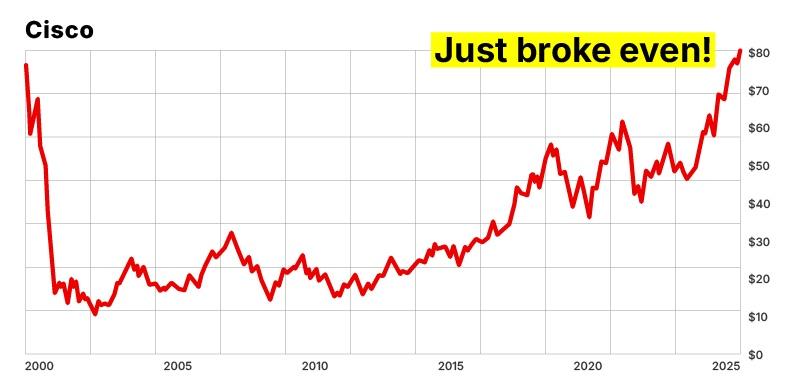
Cisco was once the MOST valuable company on Earth. Then it fell 80% - and investors waited 25 YEARS just to break even.
A Wall Street legend is out with a new warning: "It's about to happen again." He says many of today's overhyped AI darlings - stocks sitting in almost every 401(k) in America - could lose up to HALF their value or more.
He just went on camera with the names.
Wall Street's Five Biggest Banks Are on Pace for Their Best Trading Year Ever.
JPMorgan (JPM), Goldman Sachs (GS), Morgan Stanley (MS), Bank of America (BAC), and Citigroup (C) are on pace for combined trading revenue of roughly $180 billion in 2026. That would be the best trading year ever, surpassing records from the 2009 financial crisis. Equity trading alone surged 71 percent group-wide.
JPMorgan is approaching $1 trillion in market value, the first U.S. bank to reach that level. Goldman, Morgan Stanley, and Bank of America each hit all-time highs. JPMorgan's CFO summarized it: "The market is clearly extremely risk-on. We're kind of takers of that."
Single-stock volatility recently hit levels not seen since the dot-com bubble. Retail volumes are running at more than double 2024 levels. This is retail and institutional both piling into individual AI-adjacent names simultaneously.
The Trading Revenue Signal
• Group on pace for $180 billion, exceeding the 2009 financial crisis record
• Equity trading up 71 percent group-wide, JPMorgan up 86 percent
• Single-stock volatility at dot-com-era levels in Micron and AMD
• Citadel Securities saw record retail volumes in May and June
Dot-com-era volatility drove record bank trading revenue then too. What followed was not more records. Q3 trading revenue above $40 billion confirms the environment as structural. Anything below names Q2 as the specific peak.
The Composition Risk
The composition of the boom matters as much as the scale. Concentrated retail leverage in a single sector creates a specific vulnerability if one name cracks and forces the whole silo to unwind.
Apollo Said the 60/40 Portfolio Is Dead. The New Split Is AI Versus Non-AI.
Apollo's chief economist Torsten Slok named the specific reality. "The new 60-40 is AI vs. non-AI." Nine of the S&P 500's ten largest companies are now AI-tied. The only exception is Eli Lilly. Together they make up roughly 40 percent of the index. Nvidia (NVDA) alone is 7.5 percent.
Eighty-seven percent of all venture capital in 2026 has flowed to AI companies. AI infrastructure accounts for 49 percent of all new investment-grade bond issuance. Slok estimates the AI data-center buildout will drive roughly half of expected U.S. GDP growth this year. A slowdown in that buildout does not just hurt AI equity valuations. It cuts GDP by a full percentage point.
The spillover question is what Q2 earnings season is specifically testing. The Magnificent Seven have done well. Whether that spreads to the other 493 is still unresolved.
The Concentration Signal
Any investor in a passive S&P 500 index fund is running approximately 40 percent AI exposure whether they chose it or not. That is the specific problem with conventional diversification in 2026.
"A Dangerous Financial Plan Unfolding in D.C. Could Cost You 40% of Your Wealth"
Former Goldman Sachs executive who traded through Black Monday warns this plan is all written down in black and white, spearheaded by a financial insider who infiltrated the Federal Reserve... It's gone "viral" in the hedge fund circles… and yet practically nobody on Main Street understands this financial shock playing out across America. He lays out all the evidence... plus a detailed roadmap for exactly what to do. (And it doesn't require shorting... options... or perfectly "timing the market.")
You must see this critical market briefing today.
This ad is sent on behalf of Stansberry Research, 1125 N Charles St, Baltimore, MD 21201. If you would like to optout from receiving offers from Stansberry Research please click here.
Hyundai Workers Struck Over Humanoid Robots. First Time in Auto Industry History.
Hyundai Motor auto workers in South Korea went on partial strike, refraining from four hours of work per day. The explicit target is Atlas, Hyundai's humanoid robot unveiled at CES in January. First factory stoppage in auto history addressing humanoid deployment directly.
The strike could disrupt production of roughly 5,000 vehicles and cost around $134 million. Atlas pays for itself within about two years. Hyundai is deploying it at its nonunionized Georgia Metaplant by 2028 regardless of the Korean outcome. Tesla expects Optimus production by year-end. GM added dozens of collaborative robots at its Detroit plant while laying off roughly 1,000 workers.
This is the opening negotiation of a labor-capital dispute that plays out across every major automaker in the next three years.
The Labor Template Signal
• Union demands include fixed salary to guard against work hour reductions
• Retirement age extension to 65 and AI-linked bonuses also on the table
• Hyundai deploying Atlas at nonunionized Georgia Metaplant by 2028 regardless
• UAW President called humanoid deployment "one of the most profound technological revolutions"
The Bargaining Signal
UAW formally adding humanoid restrictions to upcoming contract demands confirms the Hyundai template as the new labor-capital standard for manufacturing. Silence names the U.S. auto industry as preparing to accept deployment without formal negotiation.
United Said Fuel Could Add $6 Billion to Its 2026 Costs. The IEA Said Weeks Not Months.
United Airlines (UAL) beat Q2 estimates but guided Q3 below expectations. Jet fuel prices are up 34 percent in July alone. United warned that higher fuel costs could add nearly $6 billion to 2026 expenses versus its start-of-year expectations. Q2 fuel costs already rose 84 percent year-over-year.
Demand is absorbing the higher fares so far. But IEA Executive Director Fatih Birol set a specific deadline at the Aspen Security Forum. The global economy faces "peril" if Hormuz is not "unconditionally open" in "weeks, not months."
The Gulf Coast crack spread hit an all-time high above $62 per barrel. Refiners are minting money on the same fuel costs eating airline profits. The pain is real and unevenly distributed.
The Fuel Cost Signal
Delta (DAL) or United announcing capacity cuts in the next 30 days names the fuel absorption as reaching its limit. Full schedules through Q3 confirm that pricing power still covers the cost. Birol's weeks-not-months window sets the specific deadline for which scenario plays out.
AI CEO Issues Code Red: Prepare for Meltdown
The CEO of this AI company (click here to get the name, 100% free) just issued a CODE RED in an internal memo…
Warning his employees that they’re dealing with a critical situation.
Another company executive even implied they might need a government bailout.
And now Jim Rickards is predicting this company is about to go bust, in a full-blown AI meltdown that could be 10 times bigger than Lehman Brothers.
Warsh Said Nothing on Rates. Cook Said She Is "Prepared to Act." Williams Said Hold.
Warsh completed two days of congressional testimony with zero signal on July 28-29. His explicit instruction to markets: "Play the ball, not the Fed." He acknowledged the AI buildout will push prices higher but refused to call it inflationary. That framing is now the fault line inside the FOMC.
Fed Governor Lisa Cook said she is prepared to act if disinflation does not appear soon. NY Fed President Williams said policy is "well positioned" and sees no need for a July hike. Half of Warsh's 18 colleagues expect a hike by year-end. Warsh did not submit a dot.
Two soft inflation prints pulled July hike odds to roughly 15 percent. But Cook's language keeps the hawkish wing alive. Dallas Fed President Lorie Logan and Vice Chair Philip Jefferson were the last public voices before the blackout. What they said sets the institutional temperature Warsh walks into on July 28.
The FOMC Split Signal
Logan joining Cook's "prepared to act" framing confirms July as institutionally live despite soft inflation data. Logan and Jefferson staying neutral confirms Williams's "well positioned" as the operative frame. Warsh enters his first FOMC meeting with a split committee and a silence that gave neither wing any cover.
Wall Street's five biggest banks are heading for their best trading year ever. Apollo declared AI versus non-AI as the new portfolio framework. Hyundai workers staged the first auto strike in history over humanoid robots. United warned of $6 billion in added fuel costs as the IEA named a weeks-not-months deadline for Hormuz. And Warsh left a split committee heading into blackout with July hike odds at 15 percent and Cook openly prepared to move.
The productivity gains are real. The stress tests are arriving at the same time.
